When I Thought I Was a Green...


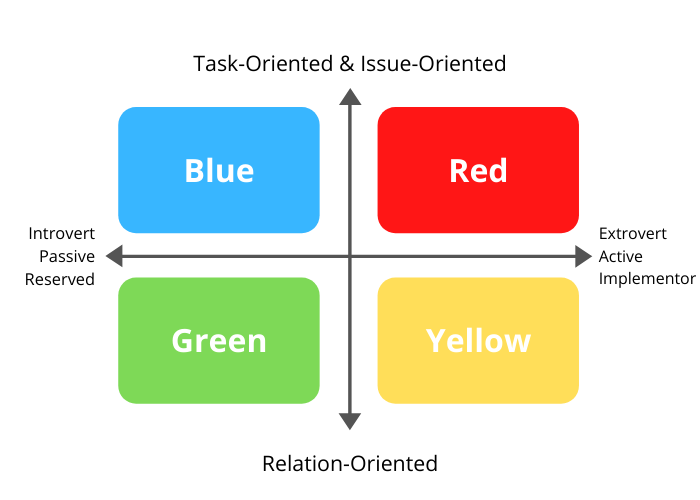
I recently read Surrounded By Idiots by Thomas Erikson. It is a commentary and analysis of human behavior using the DISC Assessment.

As I was reading, naturally, I began to assess myself. I thought I was a Green/Blue - turns out I am a Blue, with a high degree of Red. Haha...I guess Reds really do not know themselves.

But, as I thought more about it, I think people have different personalities when dealing with different situations. Especially in a more "traditional" culture as the one we have here in Southeast Asia where speaking out and initiating conflicts can be considered sinful, people tend to be chameleons. 

As the book focused on the dynamic and personalities in the workplace, now, that I think about it...yes, I am a Blue/Red in the office. I love doing data analysis to guide decision-making and I need a high level of convincing to change my thoughts. I can only work with *certain* people - I work best with high performers as I have very very low patience level at work. Of course, the most "Red" aspect of me is that I do not care how, I just need to know that the job is done. Heh.

My biggest problem with my Red personality is that I tend to miss small details. I prioritize in deciding rather than investing time into the process of deciding. Therefore, I tend to miss details and having to later revise back the decision. This is always a waste of time, which is a huge frustration.

I found a solution (from a book, I cannot remember which) - every time I feel that I am about to make a quick decision, I imagine that I am driving. When we drive, we need to keep a certain distance from the vehicle in front of us to avoid a crash. So, I visualize the decision as the car in front and I create a distance. So, I slow myself down from making a snap decision to avoid a crash. 

This book really helps me as a Blue/Red to be more understanding towards other people - especially those who are overly-excited Yellows and indecisive Yellows.

Highly recommended, will definitely write another reflection on it. 


Comments

Popular posts from this blog

Here Is Eid of 2025

Eid is about winning - the celebration for Muslims who succeeded in conquering their worldly wants and ego during Ramadhan. But it does not always feel like a happy occasion for some. I had a very interesting Eid this year (maybe because I took leave for one whole week and accidentally became the main adult in the house đŸ˜’) My beloved grandmother passed away in 2020 on the evening of the first day of Eid. She was our matriarch, and it was hard adjusting to our lives without her. Eid and Ramadhan were always her thing - she would plan all the meals and celebrations, the house visits, the guests' schedules and all the other important stuff. We all miss her, of course: my parents, my aunts and uncles, my siblings, my children, my cousins, and all those who knew her. But I think that hiding in grief would be an insult to her memory. She was always someone who was welcoming whenever guests were over - nothing made her happier than meeting her relatives and friends and making sure they h...

"Chronic": Creating Change and Space For Those Deemed Unchangeable

These past few months, we handled 2 cases of employees with chronic conditions that felt like they were mistreated. One complained that her medical leave certificate was rejected, and another complained that she was unfairly transferred out of her department.  As we dived into the cases, I noticed that some managers tend to not have the courtesy, or should I say, bravery , to take the lead in discussing the chronic conditions together with the employees. Some managers just take the chronic condition at face value, some did not even bother to actually confirm the condition and just accept rumours, and not doing anything to help. Of course, it is understandable to think that by acknowledging the condition, the employees may "bully" the managers to get what they want. But, some employees with chronic conditions may actually need genuine help, and we may miss this group of people. Having a chronic medical condition, be it physical or mental, is not something someone wishes upon t...

10 Years: The First Step - The Cynefin Framework

During a recent read, I learned about the Cynefin Framework: (Source: HBR article here ) I think this is an interesting framework. It helps me to categorize each conflict and how best to first approach it. The framework arranges the steps in order of priority for each category.  There are four areas in which I can classify a problem which I am facing: Simple, Chaos, Complicated, Complex and Disorder. In each area, except for Disorder, the responses are arranged in the order in which one we should do first.  Simple problems are problems which we have faced before and we have already formed a strategy to solve previously, which are our "Best Practice". In facing a Simple problem, we first have to sense it, which means recognizing it as a problem that we have a strategy for. We then categorize the problem to respond to it with our Best Practice. For example, in an outpatient clinic, a patient comes with fever and the doctor senses and categorizes the fever and responds with a tr...